
 Anıl Şenocak

Business Problem & Why This Solution Matters
The Challenge
In modern distributed systems, we often need to:
- Send a request and wait for a specific response
- Maintain correlation between requests and responses
- Implement timeout mechanisms for reliability
- Handle multiple concurrent requests efficiently
Traditional messaging with Kafka is fire-and-forget (asynchronous), but many business scenarios require synchronous behavior:
- Financial transactions: Need immediate confirmation
- User authentication: Must wait for validation response
- Data validation: Require real-time feedback
- API gateways: Need to aggregate responses from multiple services
The Solution
This implementation leverages RabbitMQ’s native RPC pattern which provides:
- Built-in correlation ID support through message properties
- Direct response routing using replyTo queue specification
- Instance-specific response queues for multi-instance deployments
- Push-based message delivery (no polling required)
- Automatic connection management and recovery
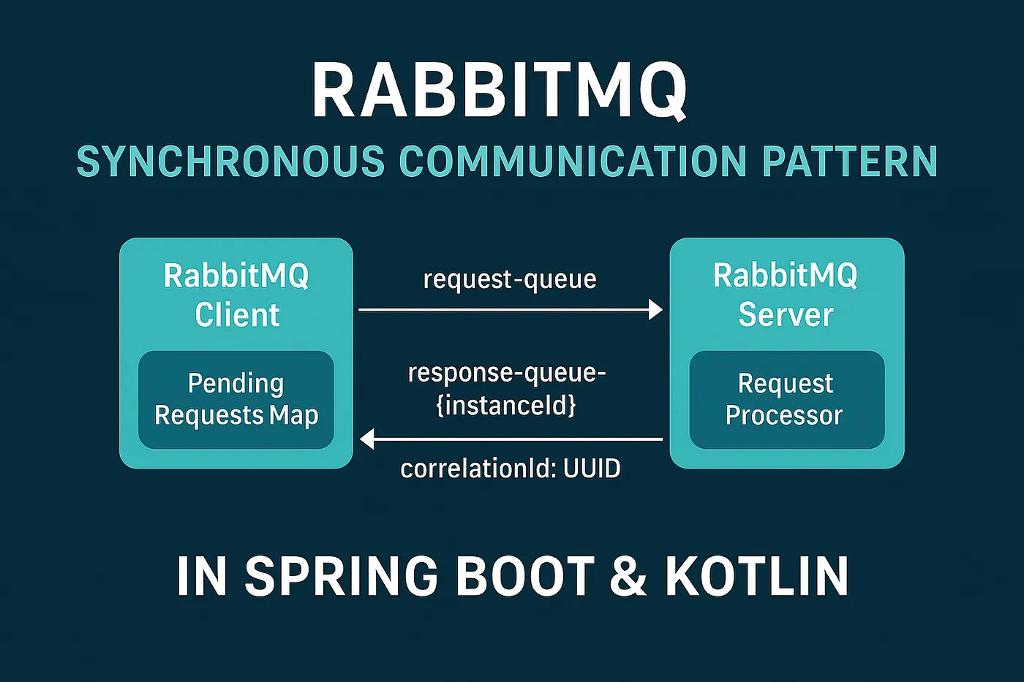
Architecture Overview
┌─────────────────┐    request-queue    ┌─────────────────┐
│ RabbitMQ Client │ ──────────────────► │ RabbitMQ Server │
│                 │                     │                 │
│ ┌─────────────┐ │  replyTo: response- │ ┌─────────────┐ │
│ │Pending      │ │  queue-{instanceId} │ │Request      │ │
│ │Requests     │ │                     │ │Processor    │ │
│ │Map          │ │ correlationId: UUID │ │             │ │
│ └─────────────┘ │                     │ └─────────────┘ │
│                 │ ◄────────────────── │                 │
└─────────────────┘  response-queue-    └─────────────────┘
                     {instanceId}
Key Components
RabbitMQSyncClient
Purpose: Sends synchronous requests and waits for responses using RabbitMQ’s RPC pattern
Key Features:
- Correlation ID Management: Each request gets a unique UUID
- Instance-Specific Response Queues: Creates response-queue-{instanceId} for each client instance
- Timeout Handling: Configurable request timeout (default: 30 seconds)
- Concurrent Request Support: Uses ConcurrentHashMap to track multiple pending requests
- Native RabbitMQ RPC: Utilizes replyTo and correlationId message properties
Implementation Highlights
fun sendSyncRequest(request: String): String {
    val correlationId: UUID = UUID.randomUUID()
    val future = CompletableFuture<String>()
    pendingRequests\[correlationId\] = future

    // RabbitMQ RPC properties - native support for request-response
    val props: AMQP.BasicProperties = AMQP.BasicProperties.Builder()
        .correlationId(correlationId.toString())
        .replyTo(responseQueue)  // Instance-specific response queue
        .build()

    // Send request with RPC properties
    channel.basicPublish("", rabbitMQProperties.requestQueue, props, request.toByteArray())
    log.info("Sent request to queue ${rabbitMQProperties.requestQueue} with correlationId: $correlationId")

    return try {
        // Block until response is received or timeout occurs
        future.get(rabbitMQProperties.requestTimeout, TimeUnit.MILLISECONDS)
    } catch (e: Exception) {
        pendingRequests.remove(key = correlationId)
        log.error("Request timed out or failed. Exception: ${e.localizedMessage}")
        throw RuntimeException("Request timed out or failed", e)
    } finally {
        log.info("Request with correlationId: $correlationId completed")
        future.complete(null)
    }
}
Response Consumer Setup (Push-based, no polling)
override fun start() {
    // Create connection and channel
    connection = connectionFactory.newConnection()
    channel = connection.createChannel()

    // Declare queues
    channel.queueDeclare(rabbitMQProperties.requestQueue, true, false, false, null)
    channel.queueDeclare(responseQueue, true, false, false, null)

    // Set up push-based response consumer
    val deliverCallback = DeliverCallback { consumerTag: String, delivery: Delivery ->
        val correlationId: UUID? = UUID.fromString(delivery.properties.correlationId)
        val response: String = String(bytes = delivery.body)
        log.info("Received response for correlationId: $correlationId")

        // Complete the pending request
        val future: CompletableFuture<String>? = pendingRequests.remove(key = correlationId)
        future?.complete(response)
    }

    // Start consuming responses (push-based delivery)
    channel.basicConsume(responseQueue, true, deliverCallback) { consumerTag ->
        log.info("Consumer was cancelled: $consumerTag")
    }

    running = true
    log.info("RabbitMQ client started with instance ID: ${rabbitMQProperties.instanceId}")
}
RabbitMQSyncServer
Purpose: Processes requests and sends responses back to the appropriate client using RPC pattern
Key Features:
- Request Processing: Listens to request-queue
- Dynamic Response Routing: Uses replyTo property to send responses to correct client queue
- Correlation ID Preservation: Maintains correlation ID through the request-response cycle
- Automatic Response Generation: Processes requests and generates responses
- Error Resilience: Handles malformed requests gracefully
override fun start() {
    // Create connection and channel
    connection = connectionFactory.newConnection()
    channel = connection.createChannel()

    // Declare request queue
    channel.queueDeclare(rabbitMQProperties.requestQueue, true, false, false, null)

    // Set up request consumer
    val deliverCallback = DeliverCallback { consumerTag: String?, delivery: Delivery ->
        val request: String = String(bytes = delivery.body)
        val correlationId: String? = delivery.properties.correlationId
        val replyTo: String? = delivery.properties.replyTo

        log.info("Received request: $request from queue: ${rabbitMQProperties.requestQueue}")

        if (correlationId != null && replyTo != null) {
            // Process business logic
            val processedResponse = processBusinessLogic(request, correlationId)

            // Send response using RPC pattern
            sendResponse(replyTo, correlationId, processedResponse)
        } else {
            log.error("Received request without correlationId or replyTo")
        }
    }

    // Start consuming requests
    channel.basicConsume(rabbitMQProperties.requestQueue, true, deliverCallback) { consumerTag ->
        log.info("Consumer was cancelled: $consumerTag")
    }

    running = true
    log.info("RabbitMQ server started")
}
Processing Flow Explained:
- Direct Queue Consumption: Listens directly on request queue (no polling)
- Property Extraction: Safely extracts correlation ID and replyTo from message properties
- Business Logic Processing: Processes the actual request content
- Direct Response Routing: Uses replyTo to send response to correct client instance
Native RPC Response Routing
private fun sendResponse(replyTo: String, correlationId: String, response: String) {
    // Create response properties preserving correlation ID
    val props: AMQP.BasicProperties = AMQP.BasicProperties.Builder()
        .correlationId(correlationId)
        .build()

    // Send response directly to client's response queue
    channel.basicPublish("", replyTo, props, response.toByteArray())
    log.info("Sent response to queue: $replyTo with correlationId: $correlationId")
}

private fun processBusinessLogic(request: String, correlationId: String): String {
    // Simulate business processing
    return "Processed: $request. Correlation ID: $correlationId. ${Random.nextInt(until = 1000)}"
}
- Direct Routing: No topic/exchange complexity, direct queue-to-queue communication
- Correlation Preservation: Correlation ID maintained in message properties
- Automatic Acknowledgment: Uses auto-acknowledge for simplicity
- Error Isolation: Failed messages don’t affect other processing
Configuration
Application Properties (application.yml)
rabbitmq:
  host: localhost
  port: 5672
  username: anil
  password: senocak
  request-queue: request-queue
  response-queue-prefix: response-queue
  request-timeout: 30000
Docker Compose Setup
rabbitmq:
  image: rabbitmq:3.8-management
  environment:
    RABBITMQ_DEFAULT_USER: anil
    RABBITMQ_DEFAULT_PASS: "senocak"
  ports:
    - "5672:5672"    # AMQP protocol
    - "15672:15672"  # Management UI
Advanced Features
Instance Isolation
Each application instance gets its own response queue:
- response-queue-{instanceId} prevents response mix-ups in multi-instance deployments
- Enables horizontal scaling without message conflicts
- Each client instance consumes only its own responses
Native RPC Pattern
- Built-in Correlation: Uses RabbitMQ’s native correlationId property
- Direct Reply Routing: Leverages replyTo property for response routing
- No Custom Headers: Uses standard AMQP message properties
- Simplified Implementation: Less code compared to custom correlation logic
Connection Management
- Automatic Recovery: RabbitMQ client handles connection failures
- Channel Per Component: Separate channels for client and server
- Graceful Shutdown: Proper cleanup of resources on application stop
RabbitMQ vs Kafka Comparison
+---------------------------+--------------------------+------------------------------+----------+
| Feature | RabbitMQ Sync | Kafka Sync | Winner |
+---------------------------+--------------------------+------------------------------+----------+
| Implementation Complexity | Low (native RPC) | High (custom correlation) | RabbitMQ |
| Lines of Code | ~50 lines | ~100+ lines | RabbitMQ |
| Message Properties | Native AMQP properties | Custom headers | RabbitMQ |
| Response Delivery | Push-based (immediate) | Poll-based (100ms delay) | RabbitMQ |
| Latency | Lower (~1-5ms) | Higher (~10-50ms) | RabbitMQ |
| Setup Complexity | Simple queue declaration | Topic + partition management | RabbitMQ |
| Throughput | Medium (10K req/sec) | Very High (100K+ req/sec) | Kafka |
| Persistence | Queue-based | Log-based | Kafka |
| Horizontal Scaling | Good | Excellent | Kafka |
+---------------------------+--------------------------+------------------------------+----------+
When to Use This Pattern
✅ Perfect Use Cases for RabbitMQ Sync
- Low-Latency RPC: Need sub-10ms response times
- Simple Request-Response: Straightforward RPC patterns
- Medium Throughput: Up to 10,000 requests/second
- Traditional Messaging: Familiar queue-based patterns
- Quick Implementation: Need rapid development
- Enterprise Integration: Integrating with existing RabbitMQ infrastructure
❌ When Kafka Sync Might Be Better
- Ultra-High Throughput: >50,000 requests/second
- Event Streaming: Need event log capabilities
- Complex Routing: Multiple consumers per message
- Long-term Storage: Need message replay capabilities
Conclusion
The RabbitMQ synchronous pattern provides a production-ready solution for scenarios requiring:
- Low-latency request-response communication
- Reliable message delivery with built-in acknowledgments
- Simple implementation with native RPC support
- Enterprise-grade features out of the box
This implementation demonstrates RabbitMQ’s strength in traditional messaging patterns while maintaining the scalability benefits of message queuing. It’s ideal for microservice architectures where you need reliable, fast synchronous communication without the complexity of implementing custom correlation logic.
This implementation demonstrates RabbitMQ’s strength in traditional messaging patterns while maintaining enterprise-grade reliability and performance characteristics ideal for synchronous communication requirements.
Full code example can be found in github