
 Anıl Şenocak
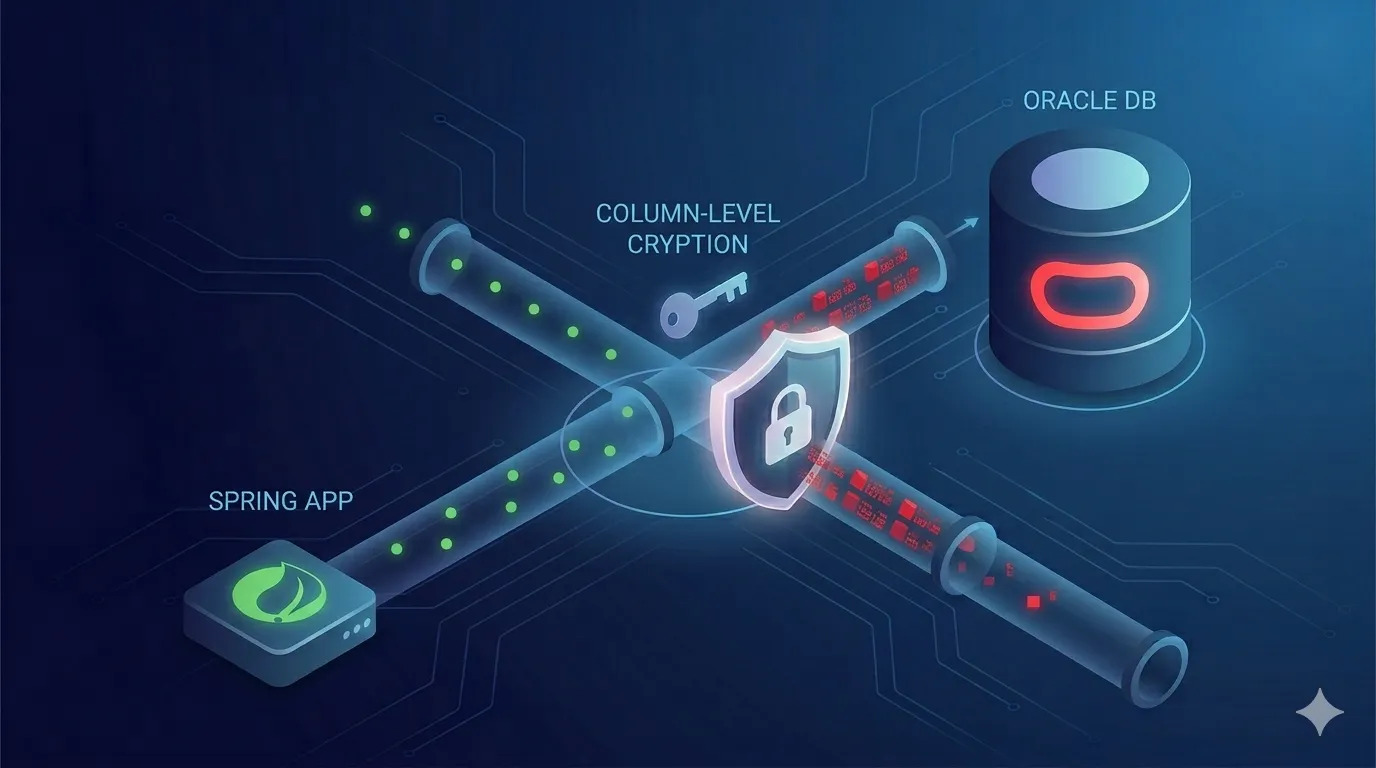

Most "the database is encrypted" stories stop at Transparent Data Encryption (TDE) the datafiles, redo logs, and backups are encrypted on disk, so an attacker who steals the raw .dbf files or a tape backup gets ciphertext. That's necessary but not sufficient. Once anyone, a DBA, an analyst with read-only access, an attacker who phished a service account, an unauthorized tool that landed a SELECT * query opens a connection to the database, TDE has already decrypted everything for them. The whole "encryption" boundary lives at the storage layer, not at the column.
For regulated data (national-ID numbers, phone numbers, addresses under KVKK/GDPR; cardholder data under PCI-DSS; PHI under HIPAA), this gap matters: a leak through a legitimate DB connection is the most common breach path, not raw disk theft. The mitigation is column-level encryption the bytes physically stored in the firstname / lastname columns are ciphertext, and decryption only happens when the right key is presented. A DBA running SELECT firstname FROM users sees HEXTORAW('A8C1...'), not Anıl.
GitHub - senocak/Spring-Oracle-Column-Level-Encryption-Decryption: Spring Oracle Column Level
The naive way to do this is to encrypt in the application call a crypto.encrypt(...) helper before every repository.save() and a crypto.decrypt(...) after every findBy*(). This works for trivial CRUD but falls apart fast:
- Every query path has to remember. Native queries, reporting jobs, batch importers, JdbcTemplate one-offs, raw
EntityManager.createQuerycalls each one is an opportunity to forget the wrapper and either store plaintext or read ciphertext as garbage. WHERE/LIKE/ORDER BYbreak. The database can only compare what it can see. If the column is ciphertext, aLIKE '%anıl%'predicate matches nothing — you either have to pull every row to the app and filter in memory, or build an awkward "encrypt the search term and compare ciphertext" path that only works for exact equality with a deterministic cipher.- Migrations and ad-hoc fixes hurt. Anyone running a Flyway script or a one-off
UPDATEhas to know the encryption convention and apply it manually. - The leak surface is wide. Every Kotlin call site, every test fixture, every seed data loader has to be reviewed. Miss one, and that column ends up half-encrypted forever.
The Solution
What this project solves: the encryption boundary is pushed down into the database into a pair of SQL functions (encrypt_text / decrypt_text) that are the only point at which plaintext and ciphertext meet. Hibernate's @ColumnTransformer then makes the application physically unable to bypass them: every query Hibernate generates including JPA Criteria predicates used for LIKE filtering is rewritten at the ORM level to call those functions.
Application code reads and writes Kotlin String values exactly as if the column were unencrypted; WHERE firstname LIKE '%anıl%' works against the decrypted value because the SQL Hibernate sends is WHERE LOWER(decrypt_text(firstname)) LIKE ?. Backups, exports, replicas, and SELECT * from a DBA's IDE all see ciphertext. The only way to read plaintext is to be a session that holds the key, and the key never appears in application code at all.
This project shows how to push column-level encryption into the database while keeping the application code free of any awareness of it. The Spring/Kotlin/JPA layer reads and writes plain Kotlin String values; ciphertext lives only inside the database column, and the encryption/decryption hop happens inside a pair of SQL functions that the database invokes on every read and write.
The entity declares an encrypt_text(text) / decrypt_text(raw) function pair and wires them into the column via @ColumnTransformer. Hibernate then rewrites every generated query to call those functions automatically.
Core idea
Hibernate’s @ColumnTransformer lets you inject a SQL expression around a column on read and on write. Anywhere Hibernate would emit SELECT firstname FROM users it instead emits SELECT decrypt_text(firstname) FROM users, and anywhere it would emit INSERT ... VALUES (?) it emits INSERT ... VALUES (encrypt_text(?)). Critically, this applies to every Hibernate-generated query - including JPA Criteria queries used for filtering - so a LIKE '%anıl%' on firstname becomes a LIKE on the decrypted value, transparently.
The entity declaration is the whole contract:
@Entity
@Table(name = "users")
class User(
    @Column(name = "firstname", nullable = false, columnDefinition = "RAW(2000)")
    @ColumnTransformer(
        read  = "decrypt_text(firstname)",
        write = "encrypt_text(?)"
    )
    var firstname: String,

    @Column(name = "lastname", nullable = false, columnDefinition = "RAW(2000)")
    @ColumnTransformer(
        read  = "decrypt_text(lastname)",
        write = "encrypt_text(?)"
    )
    var lastname: String
) : BaseDomain()
From this point on, the rest of the application ( UserRepository, the /users controller, the JPA Specification that builds LIKE predicates) is written as if firstname and lastname were ordinary VARCHAR columns.
How a request flows end-to-end
GET /users?firstname=Anıl3&lastname=Senocak3 triggers the following:
- Controller builds a JPA
Specificationcontaining twoLIKEpredicates againstroot.get("firstname")androot.get("lastname"). - Hibernate plans the query. Because of
@ColumnTransformer(read = ...), the projected columns and the predicate columns are rewritten to wrap the raw column indecrypt_text(...). The resulting SQL looks like:
SELECT decrypt_text(firstname), decrypt_text(lastname), id, created_at
FROM   users
WHERE  LOWER(decrypt_text(firstname)) LIKE ?
AND  LOWER(decrypt_text(lastname))  LIKE ?
- Database executes
decrypt_textper row, compares the result to the bind parameter, returns plaintext over the wire. - JPA hydrates
Userinstances with the decrypted strings; Jackson serializes them to JSON.
Inserts work in mirror image. The init block in CryptoApplication:
userRepository.save(User(firstname = "Anıl1", lastname = "Senocak1"))
results in:
INSERT INTO users (firstname, lastname, created_at, id)
VALUES (encrypt_text(?), encrypt_text(?), ?, ?)
The plaintext never lands in the column. At rest, SELECT firstname FROM users returns ciphertext bytes.
`DBMS_CRYPTO` setup
DBMS_CRYPTO is a builtin Oracle package that exposes primitive cipher operations. Access has to be granted explicitly to the working schema:
GRANT EXECUTE ON DBMS_CRYPTO TO your_schema;
-- e.g. GRANT EXECUTE ON DBMS_CRYPTO TO SYSTEM;
Then define the two wrapper functions the entity expects. AES-128 in CBC mode with PKCS#5 padding is a sane symmetric default. The 16-byte key below is for demo only — see Key management for what a real deployment needs.
Quick sanity check at the SQL prompt:
CREATE OR REPLACE FUNCTION encrypt_text(p_text VARCHAR2)
    RETURN RAW
AS
BEGIN
    RETURN DBMS_CRYPTO.ENCRYPT(
        src => UTL_RAW.CAST_TO_RAW(p_text),
        typ => DBMS_CRYPTO.ENCRYPT_AES128
             + DBMS_CRYPTO.CHAIN_CBC
             + DBMS_CRYPTO.PAD_PKCS5,
        key => UTL_RAW.CAST_TO_RAW('1234567890123456')
    );
END;

CREATE OR REPLACE FUNCTION decrypt_text(p_raw RAW)
    RETURN VARCHAR2
AS
BEGIN
    RETURN UTL_RAW.CAST_TO_VARCHAR2(
        DBMS_CRYPTO.DECRYPT(
            src => p_raw,
            typ => DBMS_CRYPTO.ENCRYPT_AES128
                 + DBMS_CRYPTO.CHAIN_CBC
                 + DBMS_CRYPTO.PAD_PKCS5,
            key => UTL_RAW.CAST_TO_RAW('1234567890123456')
        )
    );
END;
The column type is RAW(2000) (declared via columnDefinition on the entity) because DBMS_CRYPTO.ENCRYPT returns RAW and the ciphertext is binary, not text. 2000 is the maximum inline RAW length in Oracle; for larger payloads, switch to BLOB and adjust the function signatures to BLOB in/out.
Cipher choice cheat sheet
DBMS_CRYPTO.ENCRYPT takes a typ argument that is the bitwise sum of three constants; algorithm + chaining mode + padding. The combination above is:
| Part | Constant | Meaning |
|---|---|---|
| Algorithm | `ENCRYPT_AES128` | AES with a 16-byte key. `ENCRYPT_AES192` / `ENCRYPT_AES256` if longer. |
| Chaining | `CHAIN_CBC` | CBC mode. The IV defaults to all zeros — see *Key management* below. |
| Padding | `PAD_PKCS5` | PKCS#5/7 padding so arbitrary-length plaintexts encrypt cleanly. |
Key management
The 16-byte literal in encrypt_text('1234567890123456') is a placeholder for the demo. For anything real:
- Keys should not live in
CREATE FUNCTIONsource. Use Oracle Wallet / Key Vault, or fetch from a secret manager at session start and stash in a context variable that the functions read from. - AES-128 CBC with a static key and a static IV (the default-all-zeros IV used here, since no
ivargument is passed) produces deterministic ciphertext — the same plaintext encrypts to the same bytes — which leaks equality and enables frequency analysis. If equality search isn't a requirement, pass a random IV per encryption and store it alongside the ciphertext, or switch toENCRYPT_AES_GCMfor authenticated encryption. - Rotate keys by re-encrypting columns with a versioned key tag — keep the version byte in the stored ciphertext so
decrypt_textcan dispatch to the right key.
What the integration test verifies
CryptoApplicationTests is a @SpringBootTest that drives the live app against a real database and asserts two properties:
1. Round-trip correctness through JPA. Save three User rows, read them back via userRepository.findAll(), confirm the strings come back identical to what was written.
2. Ciphertext at rest. Bypass Hibernate, issue raw JDBC against the users table, and confirm that the bytes physically stored in the firstname/ lastname columns are not equal to the bytes of the plaintext and are longer than the plaintext (because of the cipher block padding). This is the check that proves the encryption is real, rather than a no-op stub.
A third test exercises the Criteria-based /users?firstname=...&lastname=... filter end-to-end, including case-insensitive matching on the decrypted values, proving the read = "decrypt_text(...)" rewrite kicks in for Hibernate-built predicates and not just for fetched columns.
Running locally
- Start Oracle Free (one-time):
docker compose up -d. Listens onlocalhost:1522, serviceFREEPDB1,system/testpassword. See the comments insidedocker-compose.ymlfor the in-container steps to set the password and create a working schema if you don't want to useSYSTEM.
version: '3.7'
services:
  oracle-free2:
    image: container-registry.oracle.com/database/free:23.9.0.0
    restart: unless-stopped
    ports:
      - "1522:1521"
    environment:
      - ORACLE_PWD=testpassword
jdbc:oracle:thin:system/testpassword@//localhost:1522/FREEPDB1
SELECT encrypt_text('hello') FROM dual; -- → EBB7C703E675DB3DA397038B4C17823C
SELECT decrypt_text('EBB7C703E675DB3DA397038B4C17823C') FROM dual; -- → hello
- Connect oracle as sys dba and run:
jdbc:oracle:thin:sys/testpassword@//localhost:1522/FREEPDB1?internal_logon=sysdba
then execute this to grant the crypto permissions to the SYSTEM user (or your chosen schema):
GRANT EXECUTE ON DBMS_CRYPTO TO SYSTEM;
- Connect as
SYSTEM(or your chosen schema) and test it:
jdbc:oracle:thin:system/testpassword@//localhost:1522/FREEPDB1
SELECT encrypt_text('hello') FROM dual; -- → EBB7C703E675DB3DA397038B4C17823C
SELECT decrypt_text('EBB7C703E675DB3DA397038B4C17823C') FROM dual; -- → hello
- Create the crypto functions (one-time): run the
CREATE OR REPLACE FUNCTIONblocks from the_DBMS_CRYPTO_setup section above in the same schema that your app connects to (e.g.SYSTEM). These only need to be created once per database, not per app run. - Create the crypto functions in your target schema (the SQL block under
_DBMS_CRYPTO_setup above). The entity's@ColumnTransformercalls these by unqualified name, so they must be reachable from the connecting user's default search path. - Run the app:
./gradlew bootRun.ddl-auto=create-dropwill (re)create theuserstable withfirstname/lastnameasRAW(2000).ApplicationReadyEventseeds three rows. Server binds on:8082. - Hit the endpoint:
GET http://localhost:8082/users?firstname=Anıl3&lastname=Senocak3(seesrc/main/resources/requests.http).
Override datasource defaults with the ORACLE_URL / ORACLE_USERNAME / ORACLE_PASSWORD env vars.
Caveats and tradeoffs
- Indexes on encrypted columns are useless unless you also store a deterministic blind index (e.g. HMAC of the lowercased plaintext) in a sibling column and query against that. The current setup forces a full-table decrypt for every
LIKEfine for the demo, not fine at scale. - CPU cost is per-row. Every selected row incurs a
DBMS_CRYPTO.DECRYPTcall. Watch query plans on hot tables; a function-based index ondecrypt_text(col)would defeat the whole purpose of encrypting at rest. **ddl-auto=create-drop**inapplication.ymlis convenient for a demo but obviously not what you want in production - switch tovalidateand manage schema with explicit migrations (Flyway / Liquibase). Theencrypt_text/decrypt_textfunctions must be deployed via the same migration tooling, ahead of any column DDL that references them.- The
**RAW(2000)**ceiling means plaintexts whose ciphertext would exceed ~2000 bytes need aBLOBcolumn and the correspondingBLOBreturning function signatures. **NULL**handling: the wrappers above treatNULLplaintext the same as Oracle'sNULLarithmeticencrypt_text(NULL)returnsNULL(no row encrypted), anddecrypt_text(NULL)returnsNULL. Thenullable = falseon the JPA columns is the layer that actually enforces non-null.
GitHub - senocak/Spring-Oracle-Column-Level-Encryption-Decryption: Spring Oracle Column Level
Happy coding!